 Add to Chrome
 Add to Firefox
 Add to Edge
Causal methods for LLM development and evaluation
May 25, 2026
Large language model (LLM) development is currently driven by large-scale empirical iteration over data mixtures, reward models, routing strategies, and evaluation pipelines. Here, we argue that many central questions in LLM development and evaluation are inherently causal: What is the effect of adding a data domain during pretraining? How do annotator preferences change when LLMs generate text in a different style? Should a prompt be routed to a larger or smaller model given inference cost constraints? In general, causal methods are well-suited to such settings where interventions change outcomes but, surprisingly, are underrepresented in LLM development. Our contribution is threefold: (1) We explain how causal methods can help develop modern LLM development and evaluation: LLM development relies heavily on logged data, which are often subject to confounding and distribution shifts; evaluation uses learned but potentially biased judges; and deployment environments are non-stationary. These conditions make purely predictive approaches fragile and create opportunities for principled identification and estimation methods from causal inference. (2) We further map opportunities for causal methods in the entire LLM development pipeline, including pretraining, alignment, routing, agentic workflows, and evaluation. (3) We discuss new research opportunities around leveraging causal methods for LLM development and evaluation. Overall, we argue that causal methods are potentially underutilized for the LLM development and evaluation pipeline, despite the fact that such methods can ensure a reliable and scientifically grounded design.

Adaptive Experimentation for Censored Survival Outcomes
May 18, 2026Adaptive experimentation enables efficient estimation of causal effects, but existing methods are not designed for survival data with censoring, where event times are only partially observed (e.g., overall survival in cancer trials but with dropout). In this paper, we develop a novel framework for adaptive experimentation to estimate causal effects under right censoring. For this, we derive the semiparametric efficiency bound for the average survival effect curve as a function of the treatment allocation policy and thereby obtain a closed-form efficiency-optimal allocation policy. The policy generalizes classical Neyman allocation to survival settings by prioritizing patient strata where both event and censoring dynamics induce high uncertainty. Building on this, we propose the Adaptive Survival Estimator (ASE), an adaptive framework that learns the allocation policy and estimates the average survival effect curve sequentially. Our framework has three main benefits: (i) it accommodates arbitrary machine learning models for nuisance estimation; (ii) it is guided by a closed-form efficiency-optimal allocation policy; and (iii) it admits strong theoretical guarantees, including asymptotic normality via a martingale central limit theorem. We demonstrate our framework across various numerical experiments to show consistent efficiency gains over uniform randomization and censoring-agnostic baselines.
ConfoundingSHAP: Quantifying confounding strength in causal inference
May 11, 2026In causal inference, confounders are variables that influence both treatment decisions and outcomes. However, unlike as in randomized clinical trials, the treatment assignment mechanism in observational studies is not known, and it is thus unclear which covariates act as confounders. Here, we aim to generate insight for causal inference and answer: which of the observed covariates act as confounders? We introduce ConfoundingSHAP, a Shapley-based method for attributing confounding strength to individual covariates. Our contributions are twofold. First, we propose a Shapley game targeted to infer the confounding strength of the covariates. Our resulting Shapley values differ from the standard applications of SHAP explanations on causal targets, such as understanding treatment effect heterogeneity, which are ill-suited for our task. Second, as our task requires evaluating the value function over many adjustment sets, we provide a scalable TabPFN-based estimation that avoids exhaustive refitting. We demonstrate the practical value across various datasets, where ConfoundingSHAP provides informative explanations of which observed covariates drive confounding and thereby helps to provide more insight for causal inference in practice.
ORTHOBO: Orthogonal Bayesian Hyperparameter Optimization
May 07, 2026Bayesian optimization is widely used for hyperparameter optimization when model evaluations are expensive; however, noisy acquisition estimates can lead to unstable decisions. We identify acquisition estimation noise as a failure mode that was previously overlooked: even when the surrogate model and acquisition target are correctly specified, finite-sample Monte Carlo error can perturb acquisition values. This can, in turn, flip candidate rankings and lead to suboptimal BO decisions. As a remedy, we aim at variance reduction and propose an orthogonal acquisition estimator that subtracts an optimally weighted score-function control variate, which yields an acquisition residual orthogonal to posterior score directions and which thus reduces Monte Carlo variance. We further introduce OrthoBO: a Bayesian optimization framework that combines our orthogonal acquisition estimator with ensemble surrogates and an outer log transformation. We show theoretically that our estimator preserves the target, leads to variance reduction, and improves pairwise ranking stability. We further verify the theoretical properties of OrthoBO through numerical experiments where our framework reduces acquisition estimation variance, stabilizes candidate rankings, and achieves strong performance. We also demonstrate the downstream utility of OrthoBO in hyperparameter optimization for neural network training and fine-tuning.
Causal Inference on Networks under Misspecified Exposure Mappings: A Partial Identification Framework
Feb 03, 2026Estimating treatment effects in networks is challenging, as each potential outcome depends on the treatments of all other nodes in the network. To overcome this difficulty, existing methods typically impose an exposure mapping that compresses the treatment assignments in the network into a low-dimensional summary. However, if this mapping is misspecified, standard estimators for direct and spillover effects can be severely biased. We propose a novel partial identification framework for causal inference on networks to assess the robustness of treatment effects under misspecifications of the exposure mapping. Specifically, we derive sharp upper and lower bounds on direct and spillover effects under such misspecifications. As such, our framework presents a novel application of causal sensitivity analysis to exposure mappings. We instantiate our framework for three canonical exposure settings widely used in practice: (i) weighted means of the neighborhood treatments, (ii) threshold-based exposure mappings, and (iii) truncated neighborhood interference in the presence of higher-order spillovers. Furthermore, we develop orthogonal estimators for these bounds and prove that the resulting bound estimates are valid, sharp, and efficient. Our experiments show the bounds remain informative and provide reliable conclusions under misspecification of exposure mappings.
SurvDiff: A Diffusion Model for Generating Synthetic Data in Survival Analysis
Sep 26, 2025Survival analysis is a cornerstone of clinical research by modeling time-to-event outcomes such as metastasis, disease relapse, or patient death. Unlike standard tabular data, survival data often come with incomplete event information due to dropout, or loss to follow-up. This poses unique challenges for synthetic data generation, where it is crucial for clinical research to faithfully reproduce both the event-time distribution and the censoring mechanism. In this paper, we propose SurvDiff, an end-to-end diffusion model specifically designed for generating synthetic data in survival analysis. SurvDiff is tailored to capture the data-generating mechanism by jointly generating mixed-type covariates, event times, and right-censoring, guided by a survival-tailored loss function. The loss encodes the time-to-event structure and directly optimizes for downstream survival tasks, which ensures that SurvDiff (i) reproduces realistic event-time distributions and (ii) preserves the censoring mechanism. Across multiple datasets, we show that \survdiff consistently outperforms state-of-the-art generative baselines in both distributional fidelity and downstream evaluation metrics across multiple medical datasets. To the best of our knowledge, SurvDiff is the first diffusion model explicitly designed for generating synthetic survival data.
PrivATE: Differentially Private Confidence Intervals for Average Treatment Effects
May 27, 2025The average treatment effect (ATE) is widely used to evaluate the effectiveness of drugs and other medical interventions. In safety-critical applications like medicine, reliable inferences about the ATE typically require valid uncertainty quantification, such as through confidence intervals (CIs). However, estimating treatment effects in these settings often involves sensitive data that must be kept private. In this work, we present PrivATE, a novel machine learning framework for computing CIs for the ATE under differential privacy. Specifically, we focus on deriving valid privacy-preserving CIs for the ATE from observational data. Our PrivATE framework consists of three steps: (i) estimating a differentially private ATE through output perturbation; (ii) estimating the differentially private variance through a truncated output perturbation mechanism; and (iii) constructing the CIs while accounting for the uncertainty from both the estimation and privatization steps. Our PrivATE framework is model agnostic, doubly robust, and ensures valid CIs. We demonstrate the effectiveness of our framework using synthetic and real-world medical datasets. To the best of our knowledge, we are the first to derive a general, doubly robust framework for valid CIs of the ATE under ($\varepsilon$, $\delta$)-differential privacy.
Orthogonal Survival Learners for Estimating Heterogeneous Treatment Effects from Time-to-Event Data
May 19, 2025Estimating heterogeneous treatment effects (HTEs) is crucial for personalized decision-making. However, this task is challenging in survival analysis, which includes time-to-event data with censored outcomes (e.g., due to study dropout). In this paper, we propose a toolbox of novel orthogonal survival learners to estimate HTEs from time-to-event data under censoring. Our learners have three main advantages: (i) we show that learners from our toolbox are guaranteed to be orthogonal and thus come with favorable theoretical properties; (ii) our toolbox allows for incorporating a custom weighting function, which can lead to robustness against different types of low overlap, and (iii) our learners are model-agnostic (i.e., they can be combined with arbitrary machine learning models). We instantiate the learners from our toolbox using several weighting functions and, as a result, propose various neural orthogonal survival learners. Some of these coincide with existing survival learners (including survival versions of the DR- and R-learner), while others are novel and further robust w.r.t. low overlap regimes specific to the survival setting (i.e., survival overlap and censoring overlap). We then empirically verify the effectiveness of our learners for HTE estimation in different low-overlap regimes through numerical experiments. In sum, we provide practitioners with a large toolbox of learners that can be used for randomized and observational studies with censored time-to-event data.
Differentially Private Learners for Heterogeneous Treatment Effects
Mar 05, 2025Patient data is widely used to estimate heterogeneous treatment effects and thus understand the effectiveness and safety of drugs. Yet, patient data includes highly sensitive information that must be kept private. In this work, we aim to estimate the conditional average treatment effect (CATE) from observational data under differential privacy. Specifically, we present DP-CATE, a novel framework for CATE estimation that is Neyman-orthogonal and further ensures differential privacy of the estimates. Our framework is highly general: it applies to any two-stage CATE meta-learner with a Neyman-orthogonal loss function, and any machine learning model can be used for nuisance estimation. We further provide an extension of our DP-CATE, where we employ RKHS regression to release the complete CATE function while ensuring differential privacy. We demonstrate our DP-CATE across various experiments using synthetic and real-world datasets. To the best of our knowledge, we are the first to provide a framework for CATE estimation that is Neyman-orthogonal and differentially private.
Constructing Confidence Intervals for Average Treatment Effects from Multiple Datasets
Dec 16, 2024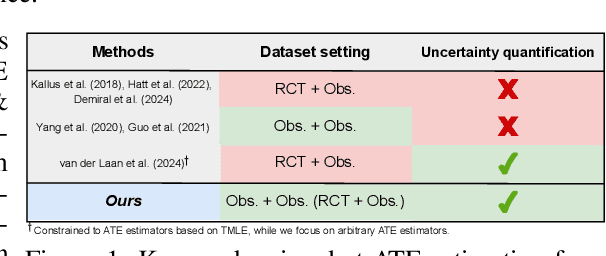

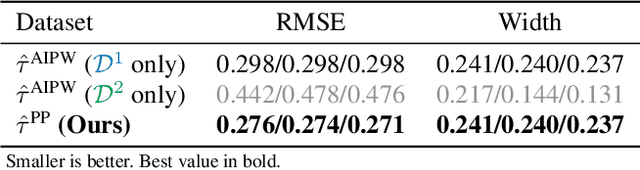
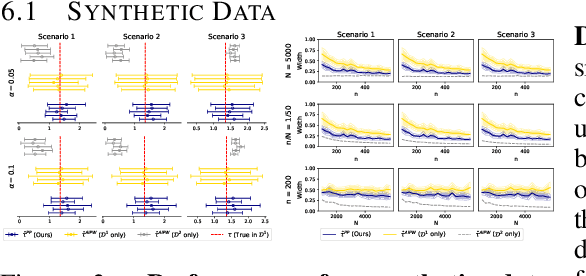
Constructing confidence intervals (CIs) for the average treatment effect (ATE) from patient records is crucial to assess the effectiveness and safety of drugs. However, patient records typically come from different hospitals, thus raising the question of how multiple observational datasets can be effectively combined for this purpose. In our paper, we propose a new method that estimates the ATE from multiple observational datasets and provides valid CIs. Our method makes little assumptions about the observational datasets and is thus widely applicable in medical practice. The key idea of our method is that we leverage prediction-powered inferences and thereby essentially `shrink' the CIs so that we offer more precise uncertainty quantification as compared to na\"ive approaches. We further prove the unbiasedness of our method and the validity of our CIs. We confirm our theoretical results through various numerical experiments. Finally, we provide an extension of our method for constructing CIs from combinations of experimental and observational datasets.